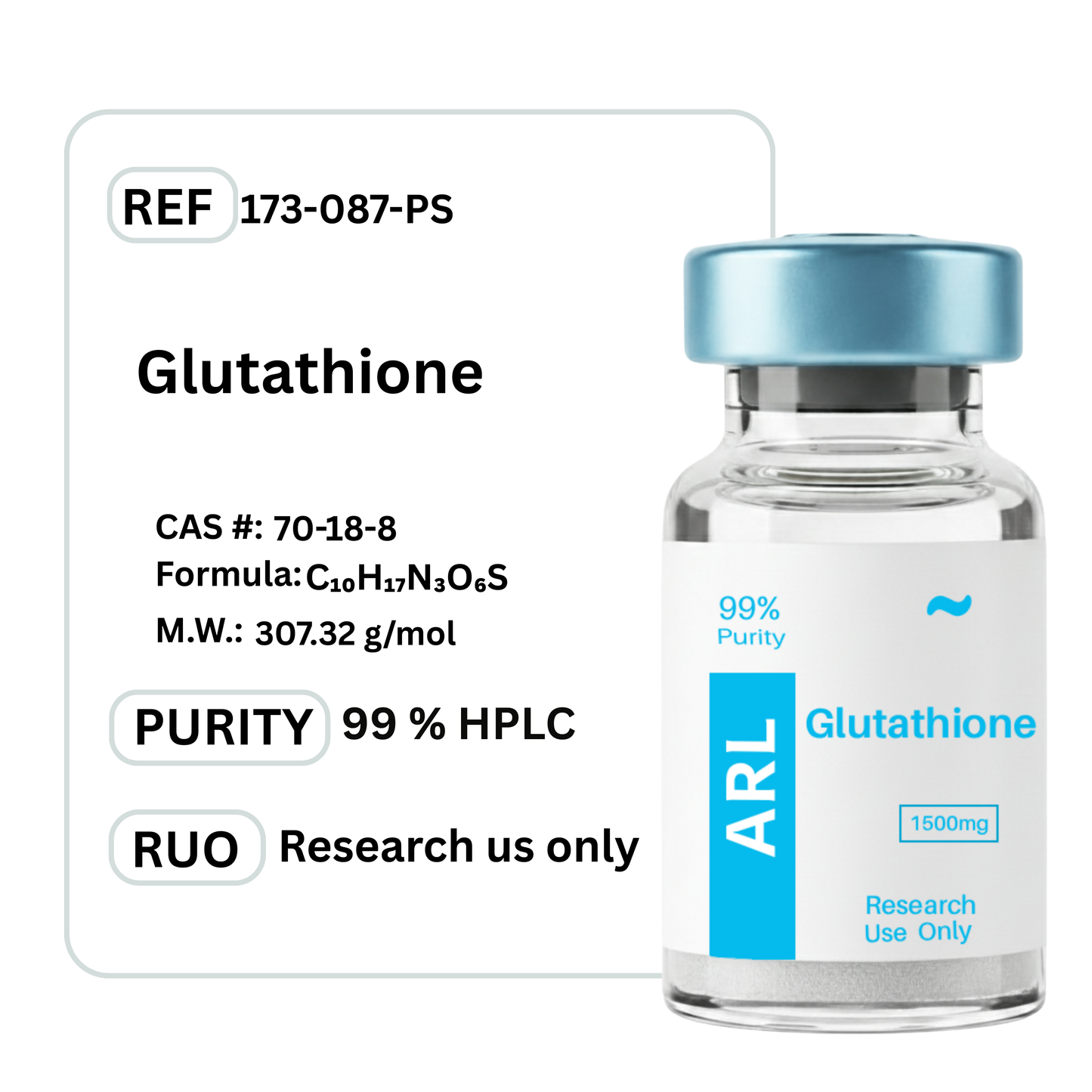
Glutathione
Glutathione
This batch of Glutathione Peptide has been third party lab tested and verified for quality.
Contents: Glutathione (L-γ-Glutamyl-L-Cysteinylglycine, Antioxidant Tripeptide)
Form: Powder
Purity: 99.3%
Couldn't load pickup availability
Free Reconstitution Solution automatically added to your cart with each order.
This product is Made, Tested & Shipped From Canada.
Ships Today
Order by 1:00 PM EST
Free Shipping
For 2 or more vials
Verified+

Glutathione: Molecular Integration and Cellular Protection Networks
Introducing Glutathione Within Biological Context
Glutathione occupies a singular biochemical position: a simple tripeptide synthesizing from three common amino acids, yet participating in hundreds of distinct biological processes simultaneously. Understanding glutathione requires recognizing how simple molecular architecture enables sophisticated physiological regulation across all cellular compartments.
The compound represents nature's elegant solution to a fundamental biological problem: organisms continuously generate reactive byproducts from metabolism that damage essential cellular machinery. Rather than eliminating these hazardous molecules through energy-intensive detoxification exclusively, cells evolved to tolerate moderate oxidative stress by maintaining powerful antioxidant systems with glutathione as the primary agent.
Glutathione Structure
Tripeptide Architecture and Chemical Reactivity
Glutathione's structure comprises three amino acids connected through peptide bonds: glutamic acid contributes the backbone framework, cysteine provides the reactive sulfhydryl (-SH) group, and glycine completes the sequence. This simple architecture—contrasting with massive antioxidant proteins—confers distinct advantages: easy synthesis, rapid turnover, and penetration into cellular compartments unavailable to larger molecules.
The sulfhydryl group represents the molecular essence of glutathione's function. This reactive chemical moiety donates electrons readily, converting oxidized glutathione (GSSG) to reduced glutathione (GSH). This interconversion between oxidized and reduced forms enables continuous cycling, permitting single glutathione molecules to neutralize numerous free radicals throughout cellular lifetime.
Redox Cycling and Free Radical Neutralization Mechanisms
When glutathione encounters reactive oxygen species—superoxide anions, hydroxyl radicals, hydrogen peroxide, lipid peroxides, or nitrogen dioxide—the sulfhydryl electron donates, neutralizing the radical while oxidizing glutathione itself. The resulting oxidized glutathione (GSSG) appears biologically inert until glutathione reductase enzyme catalyzes regeneration back to reduced glutathione.
This redox cycling represents extraordinary biochemical efficiency: rather than single-use antioxidants becoming permanently inactivated, glutathione engages in continuous oxidation-reduction cycling, enabling protection from thousands of reactive molecules throughout cellular lifespan.
Simultaneously, this cycling mechanism creates a cellular redox buffer—maintaining cellular redox potential within narrow ranges necessary for proper cellular function. Excessive oxidation (too much GSSG) triggers protective upregulation of antioxidant defenses, while excessive reduction triggers protective downregulation, maintaining homeostatic equilibrium.
Enzymatic Cofactor Functions and Catalytic Amplification
Glutathione's antioxidant importance extends beyond direct free radical neutralization into enzymatic catalysis. Glutathione peroxidase enzymes catalyze reduction of hazardous hydroperoxides using glutathione as electron donor—a mechanism enabling single enzyme molecules to detoxify numerous peroxides continuously.
Glutathione S-transferase enzymes catalyze conjugation of glutathione to electrophilic toxins, xenobiotics, and metabolic byproducts, enabling subsequent elimination via hepatic and renal excretion. These Phase II detoxification reactions represent critical mechanisms preventing accumulation of cellular toxins.
This enzymatic functionality amplifies glutathione's biological impact dramatically. Glutathione concentration alone cannot explain observed antioxidant capacity; rather, glutathione functioning as obligatory enzyme cofactor multiplies its protective impact through catalytic mechanisms.
Antioxidant Network Regeneration and Synergy
Glutathione participates within integrated antioxidant networks rather than operating in isolation. When vitamin E (α-tocopherol) neutralizes lipid peroxides within cell membranes, vitamin E becomes oxidized and biologically inactive. Glutathione reduces vitamin E back to active form—a phenomenon termed "recycling."
Similar regeneration occurs for vitamin C (ascorbic acid) and other antioxidant molecules. This network architecture enables antioxidants to function continuously rather than experiencing single-use inactivation. The synergistic interaction produces antioxidant capacity exceeding sum of individual components.
Glutathione essentially functions as the hub of the cellular antioxidant network, regenerating other antioxidants and maintaining their continuous biological function. This integrative role explains why glutathione depletion causes antioxidant system collapse—the network hub becomes non-functional, causing secondary antioxidant inactivation.
Mitochondrial Bioenergetics and Oxidative Phosphorylation
Mitochondria generate cellular energy through oxidative phosphorylation—electron transfer through protein complexes coupled to ATP synthesis. This process simultaneously generates superoxide and other reactive oxygen species as unavoidable byproducts.
Mitochondrial glutathione maintains the reducing environment necessary for proper electron transport chain function while neutralizing byproduct reactive species before damage propagates. Mitochondrial glutathione depletion causes rapid ATP production decline, triggering either apoptotic cell death or senescence.
Glutathione optimization therefore directly improves cellular energy production by protecting mitochondrial function. This mechanism explains the profound energy improvements users experience following glutathione optimization—mitochondria function at peak efficiency once protective glutathione restores.
Ferroptotic Cell Death Prevention and Iron Metabolism
Ferroptosis represents an iron-dependent cell death mechanism distinct from apoptosis. Iron catalyzes reactive oxygen species generation through Fenton reactions, causing lipid peroxidation and cellular death. Glutathione prevents ferroptosis through multiple mechanisms: antioxidant activity prevents lipid peroxidation, and glutathione peroxidase catalyzes reduction of existing lipid peroxides.
This mechanism proves particularly important in the central nervous system, where iron concentrations run high and neurons exhibit heightened ferroptosis vulnerability. Neurodegenerative diseases including Parkinson's and Alzheimer's demonstrate accelerated ferroptotic neuronal loss associated with glutathione depletion.
By preventing ferroptotic cell death, glutathione essentially extends neuronal lifespan and prevents accelerated neurodegeneration. This represents a foundational mechanism explaining glutathione's neuroprotective properties.
Immune System Redox Environment and Lymphocyte Proliferation
T-lymphocytes and other immune cells depend absolutely on proper redox environment for proliferation and cytokine production. Glutathione maintains this redox microenvironment within lymphoid tissues, enabling rapid T-cell clonal expansion during immune responses.
Glutathione concentration directly correlates with immune competence; individuals with depleted glutathione demonstrate compromised T-cell proliferation and reduced cytokine production, resulting in immunodeficiency. HIV infection causes progressive glutathione depletion and immunodeficiency through mechanisms partly independent of direct viral effects.
Glutathione optimization therefore strengthens immunity by restoring lymphoid redox environment necessary for immune cell function. This mechanism likely explains improved illness resistance observed following glutathione supplementation.
Hepatic Detoxification and Phase II Metabolism
The liver accumulates glutathione at concentrations 10-20 times higher than other tissues, reflecting hepatic specialization in toxin elimination. Glutathione S-transferase enzymes concentrate in liver, catalyzing conjugation of numerous drugs, pollutants, and metabolic byproducts to glutathione.
These conjugation reactions render hydrophobic toxins water-soluble, enabling hepatic bile excretion and renal elimination. Individuals with impaired glutathione synthesis demonstrate compromised detoxification capacity and accumulation of cellular toxins.
Glutathione optimization specifically supports hepatic function, enabling enhanced toxin elimination and reduced toxic burden. This mechanism contributes substantially to improved health outcomes beyond antioxidant benefits per se.
Neuronal Glutamate Homeostasis and Excitotoxicity Prevention
Glutamate serves essential neurotransmitter functions but demonstrates excitotoxic properties at elevated concentrations. Glutathione maintains neuronal glutamate homeostasis through multiple mechanisms: supporting astrocytic glutamate uptake transporters and preventing glutamate accumulation within synaptic spaces.
Excessive glutamate accumulation drives excitotoxic neuronal death through calcium influx and mitochondrial dysfunction. Glutathione depletion permits uncontrolled glutamate accumulation, accelerating neuronal loss in neurodegenerative conditions.
By maintaining glutathione levels, neurons preserve glutamate homeostasis and prevent excitotoxic damage. This mechanism likely contributes substantially to cognitive benefits observed with glutathione optimization.
Age-Related Glutathione Decline: Mechanistic Explanation
Glutathione synthesis declines with age through multiple mechanisms: reduced expression of glutamate-cysteine synthetase (the rate-limiting enzyme), decreased availability of cysteine precursor, and impaired transcriptional regulation of glutathione synthetic genes.
Simultaneously, age-related oxidative stress increases glutathione consumption rates, creating a "perfect storm" of declining synthesis coupled with accelerating demand. This results in profound glutathione depletion observable by age 60, with corresponding collapse of antioxidant defense networks.
The delayed manifestation of aging (maximal around age 50) reflects a threshold phenomenon: glutathione decline remains compensated through redundant defense mechanisms until crossing critical threshold points, then aging manifestations accelerate rapidly.
Delivery Mechanisms and Bioavailability Optimization
Oral glutathione demonstrates extremely limited bioavailability due to intestinal proteolysis and hepatic first-pass metabolism. Parenteral administration (subcutaneous or intramuscular injection) achieves 5-10 times superior bioavailability through direct systemic delivery.
Intranasal administration represents an alternative circumventing hepatic metabolism and achieving substantial central nervous system penetration—particularly valuable for neuroprotective applications.
This bioavailability difference explains dramatically superior outcomes from parenteral versus oral supplementation, despite some popular marketing suggesting equivalent efficacy across delivery routes.
Integrated Perspective: Systems-Level Glutathione Function
Glutathione's biological significance emerges only when integrating its diverse functions into comprehensive systems perspective. Glutathione simultaneously:
Maintains cellular redox balance enabling proper signaling and gene expression. Protects mitochondria enabling continuous ATP production. Prevents ferroptotic neuronal death preserving cognitive function. Detoxifies xenobiotics reducing toxic burden. Maintains immune redox environment enabling immunity. Regenerates oxidized antioxidants sustaining network function.
When glutathione optimizes across all systems, the cumulative effect transcends simple antioxidant benefit. Comprehensive cellular regeneration occurs, aging slows, disease risk diminishes, and vital health markers improve dramatically.
Scientific Attribution
This mechanistic integration analysis draws from research by Dr. Helmut Sies, M.D., Ph.D., who established oxidative stress as fundamental disease mechanism and glutathione as central protective agent. Collaborative contributions by Dr. Dean P. Jones, Dr. H.J. Forman, Dr. S.C. Lu, and Dr. R. Dringen have comprehensively characterized glutathione biochemistry across physiological domains.
This attribution recognizes foundational scientific contributions. Montreal Peptides Canada maintains no affiliation with cited researchers.
References
Wu G, Fang YZ, Yang S, Lupton JR, Turner ND. Glutathione metabolism and its implications for health. J Nutr. 2004 Mar;134(3):489-92.
Forman HJ, Zhang H, Rinna A. Glutathione: overview of its protective roles. Mol Aspects Med. 2009 Feb-Apr;30(1-2):1-12.
Pompella A, et al. The changing faces of glutathione. Biochim Biophys Acta. 2003 Jan 3;1583(1):1-14.
Jones DP. Redefining oxidative stress. Antioxid Redox Signal. 2006 Sep-Oct;8(9-10):1865-79.
Lu SC. Glutathione synthesis. Biochim Biophys Acta. 2013 May;1830(5):3143-53.
Dringen R. Glutathione metabolism in the brain. Prog Neurobiol. 2000 Jul;62(6):649-71.
Lushchak VI. Glutathione in cell metabolism. Chem Biol Interact. 2012 Nov 25;199(1):1-14.
-
check_circle
HIGHEST QUALITY PEPTIDES
Our products are scientifically formulated and manufactured in cGMP-compliant facilities.
-
encrypted
FAST DELIVERY
Enjoy fast and reliable 3–5 day shipping.
-
check_circle
Dedicated Customer Service
Our customer service team is highly knowledgeable in peptide research and its applications. We’re available 24/7 to assist you.
Verified reviews
Tested. Verified. Trusted.
We take a laboratory-first approach to quality. Each batch is made under controlled conditions and verified by an independent lab (HPLC/MS). We only ship batches that test ≥99% purity, and we provide a full COA, including identity, methods, and chromatograms, for your review.
You may also like
-
SAVE 25%Reconstitution Solution
Regular price $15.00Regular price $15.00 Sale priceUnit price / per$20.0025% -
KPV Tripeptide - Research Grade Peptide
Regular price From $56.00Regular price From $56.00 Sale priceUnit price / per$74.0024% -
SAVE 25%Tirzepatide
Regular price From $50.00Regular price From $50.00 Sale priceUnit price / per$67.0025% -
Thymosin Alpha-1 - Premium Research Peptide
Regular price From $79.00Regular price From $79.00 Sale priceUnit price / per$104.0024% -
SAVE 23%Tesamorelin
Regular price From $80.00Regular price From $80.00 Sale priceUnit price / per$105.0023% -
SAVE 23%TB-500 - Premium Research Peptide
Regular price From $60.00Regular price From $60.00 Sale priceUnit price / per$78.0023% -
SAVE 23%Survodutide
Regular price $299.00Regular price $299.00 Sale priceUnit price / per$392.0023% -
SAVE 26%Sterile Water
Regular price From $14.00Regular price From $14.00 Sale priceUnit price / per$19.0026% -
SAVE 23%SLU-PP-332
Regular price $125.00Regular price $125.00 Sale priceUnit price / per$164.0023% -
SAVE 23%Sermorelin
Regular price From $70.00Regular price From $70.00 Sale priceUnit price / per$92.0023% -
SAVE 23%Semaglutide
Regular price From $36.00Regular price From $36.00 Sale priceUnit price / per$47.0023% -
SAVE 23%Retatrutide Triple Agonist
Regular price From $90.00Regular price From $90.00 Sale priceUnit price / per$118.0023% -
SAVE 26%Oxytocin Acetate
Regular price $42.00Regular price $42.00 Sale priceUnit price / per$57.0026% -
SAVE 25%Melanotan II (MT2)
Regular price $50.00Regular price $50.00 Sale priceUnit price / per$67.0025% -
SAVE 24%LL-37 - Premium Research Peptide
Regular price $85.00Regular price $85.00 Sale priceUnit price / per$112.0024% -
SAVE 24%Lipo-C with B Vitamins
Regular price $85.00Regular price $85.00 Sale priceUnit price / per$112.0024% -
SAVE 23%Lemon Bottle
Regular price $80.00Regular price $80.00 Sale priceUnit price / per$105.0023% -
SAVE 23%L-Carnitine
Regular price $97.00Regular price $97.00 Sale priceUnit price / per$127.0023% -
KPV Tripeptide - Premium Research Peptide
Regular price From $56.00Regular price From $56.00 Sale priceUnit price / per$74.0024% -
KLOW Blend - GHK-CU + TB-500 + BPC-157 + KPV 10mg
Regular price $200.00Regular price $200.00 Sale priceUnit price / per$261.0023% -
SAVE 23%Kisspeptin-10
Regular price From $65.00Regular price From $65.00 Sale priceUnit price / per$85.0023% -
SAVE 23%Ipamorelin
Regular price From $32.00Regular price From $32.00 Sale priceUnit price / per$42.0023% -
SAVE 24%IGF-1 LR3 (Long R3)
Regular price From $40.00Regular price From $40.00 Sale priceUnit price / per$53.0024% -
SAVE 24%Hyaluronic
Regular price $28.00Regular price $28.00 Sale priceUnit price / per$37.0024% -
SAVE 23%HGH Fragment 176-191
Regular price $97.00Regular price $97.00 Sale priceUnit price / per$127.0023% -
SAVE 23%HGH 191AA (Somatropin)
Regular price From $55.00Regular price From $55.00 Sale priceUnit price / per$72.0023% -
SAVE 25%Gonadorelin
Regular price $50.00Regular price $50.00 Sale priceUnit price / per$67.0025% -
SAVE 23%Glutathione
Regular price $83.00Regular price $83.00 Sale priceUnit price / per$109.0023% -
SAVE 23%Glow BPC-157 + GHK-CU + TB-500
Regular price $139.00Regular price $139.00 Sale priceUnit price / per$181.0023%
Every vial we sell comes from a lab that follows current Good Manufacturing Practices (cGMP). That means each step of production is documented and controlled. Before a batch is released, it’s tested by independent third-party labs for purity, identity, and sterility. Certificates of analysis are available so you can see the exact test results.
Yes. The labs we work with use ISO-certified clean rooms where air quality, equipment, and handling procedures are tightly regulated. Staff are trained to pharmaceutical-grade standards. This ensures the peptides are produced in an environment that minimizes contamination risks.
Peptides in lyophilized (freeze-dried) form are stable at room temperature for transport. Once you receive them, refrigeration is recommended to maintain long-term integrity. We package every order securely to prevent damage and ship promptly, so your vials arrive in optimal condition.
We operate under strict in-house protocols that follow current Good Manufacturing Practices (cGMP). That means our team oversees the entire process from sourcing raw amino acids to the final lyophilized vial. Nothing is outsourced or repackaged. This gives us full control over purity, consistency, and sterility, and it’s why we can stand behind every single vial we ship.
Store them in the refrigerator, away from direct light and heat. If you need to keep them longer, some peptides can be stored frozen. Each vial comes with clear handling instructions so you know the proper conditions for stability.
The strongest proof is transparency. For every peptide, we can provide certificates of analysis, manufacturing documentation, and references to the published scientific research behind it. If you ever have questions, we’ll show you the data rather than ask you to take our word for it.
The difference is transparency. Most sites give you a product name and a price. We provide full batch testing, lab documentation, and direct access to certificates of analysis so you don’t have to guess what you’re getting. When you order from us, you know exactly what’s in the vial, where it was made, and how it was verified.