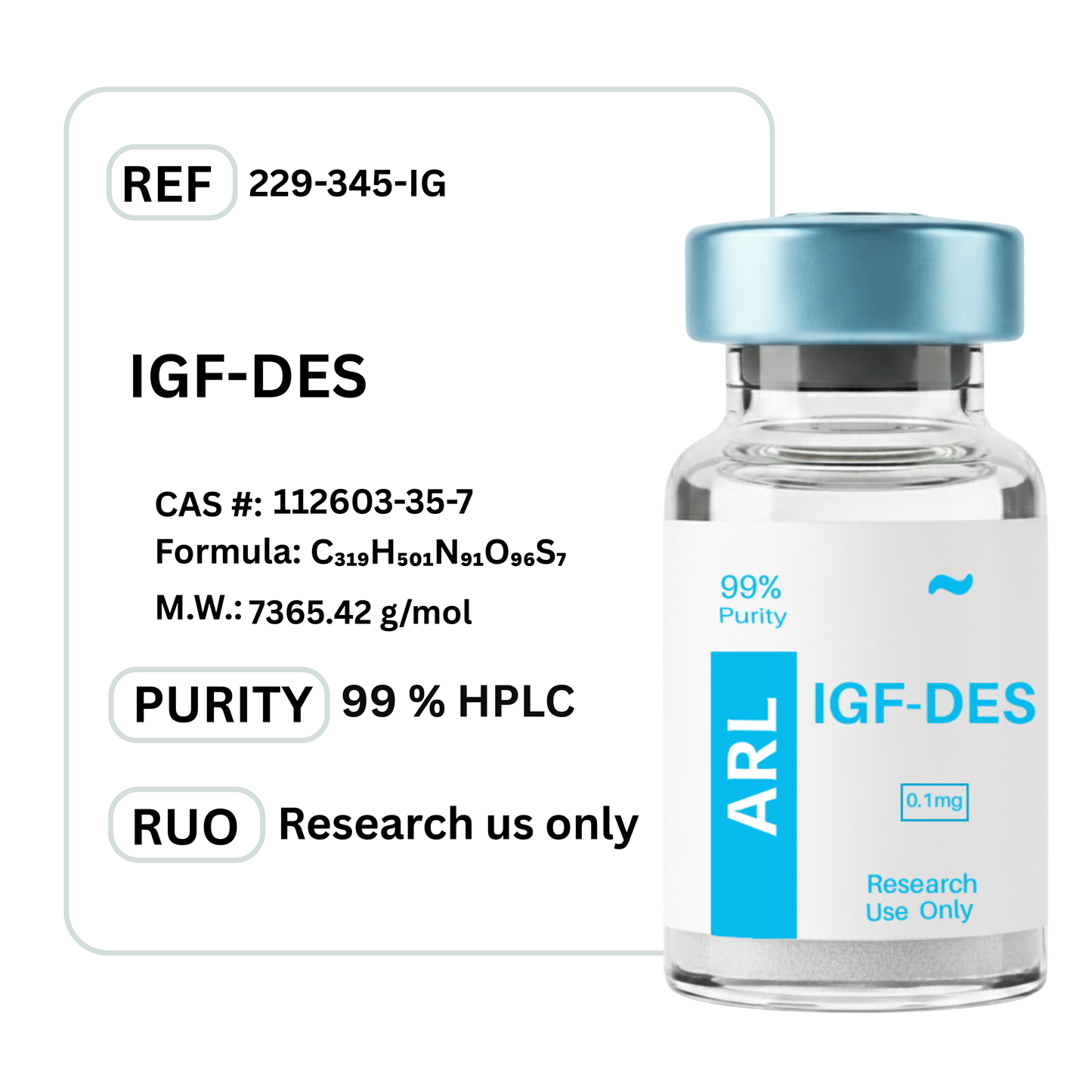
IGF-DES
IGF-DES
This batch of IGF-DES Peptide has been third party lab tested and verified for quality.
Contents: IGF-DES (Insulin-Like Growth Factor-1 DES(1-3) Analog)
Form: Powder
Purity: 99.3%
Couldn't load pickup availability
Free Reconstitution Solution automatically added to your cart with each order.
This product is Made, Tested & Shipped From United States.
Shipping & Delivery
We are committed to delivering fast, reliable, and transparent shipping for all orders. Please review our policy below for details on delivery times, tracking, and what to expect with every purchase.
View Full Shipping Policy
Verified+

Understanding IGF1-LR3
IGF1-LR3 represents an engineered variant of insulin-like growth factor-1, commonly referred to as insulin-like growth factor-1 long arginine 3. This synthetic peptide belongs to a broader classification of IGF-1 analogs that demonstrate significant involvement in cellular mitosis, proliferation mechanisms, and intercellular signaling pathways. While sharing functional similarities with native IGF-1, IGF1-LR3 exhibits reduced affinity for IGF-binding protein interactions. Consequently, the compound demonstrates an extended circulatory retention period, remaining detectable in serum approximately 120-fold longer than endogenous IGF-1. This extended pharmacokinetic profile emerges from deliberate structural modifications—the incorporation of 13 additional amino acid residues at the N-terminal region and the substitution of glutamic acid at position 3 with an arginine moiety.
IGF1-LR3 Structure
Investigational Applications of IGF1-LR3
Cellular Proliferation and Differentiation
Comparable to its parent molecule, IGF1-LR3 functions as a potent mitogenic agent, triggering rapid cellular replication and expansion. The compound exerts preferential effects on connective tissue elements, including skeletal muscle and osseous tissue, while also stimulating proliferative responses in hepatic, renal, neural, integumentary, pulmonary, and hematopoietic compartments. The mechanistic action of IGF-1 should be characterized as a differentiation-promoting hormone because it orchestrates both the multiplication and maturation of cellular populations, enabling appropriate phenotypic specification.
The extended half-life distinguishes IGF1-LR3 from conventional IGF-1, conferring substantially amplified bioactivity. Administration of equivalent IGF1-LR3 quantities generates approximately tripled cellular responses compared to identically dosed IGF-1. A critical distinction exists between hypertrophic and hyperplastic mechanisms: IGF1-LR3 and analogous IGF-1 compounds stimulate numeric expansion of cellular populations rather than individual cell enlargement. This characteristic proves advantageous for developmental processes, as cellular multiplication results in increased muscle mass through escalated fiber quantity rather than isolated fiber dimension.
Lipid Catabolism and Metabolic Disorders
IGF1-LR3 facilitates lipolytic processes through a dual-receptor engagement strategy, binding both IGF-1R and insulin receptor subtypes. These interactions enhance cellular extraction of circulating glucose via muscle, neural, and liver tissues. Such glucose sequestration precipitates systemic glycemia reduction, subsequently dampening adipose tissue accumulation alongside declining circulating insulin, lipid, and triglyceride concentrations. The cumulative effect manifests as diminished adiposity coupled with heightened catabolism.
The glucose-regulatory properties of IGF1-LR3 naturally extend to insulin modulation. Preclinical studies employing murine models of hyperglycemia demonstrate reductions in insulin requirements, with documented decreases approaching 10% in therapeutic dosage needed to maintain euglycemic states. These observations provide potential mechanistic insights for reducing insulin dependency in insulin-resistant populations and may illuminate preventative approaches for glucose-metabolism disorders.
Chronobiological and Longevity Studies
IGF-1 participates in systemic repair and regenerative processes, positioning it as a cytoprotective element against senescence-associated cellular dysfunction. Comparative analysis across bovine species and epidemiological human data suggest that diminished IGF-1 signaling correlates with accelerated aging phenotypes. Contemporary murine investigations examine whether IGF1-LR3 administration might extend survival duration and attenuate age-dependent pathologies including neurodegeneration, sarcopenia, and renal dysfunction. Current data indicate that IGF-1 supplementation can extend lifespan and reduce age-associated morbidity.
Myostatin Antagonism
Myostatin, alternatively designated growth-differentiation factor 8, functions as an endogenous suppressor of myogenic differentiation. The functional inhibition of myostatin represents a therapeutic target for conditions characterized by muscular degeneration and wasting. Myostatin blockade demonstrates potential application in neuromuscular disorders such as Duchenne muscular dystrophy, where the therapeutic objective involves arresting or reversing myofibrillar deterioration. Additionally, myostatin inhibition may benefit individuals experiencing exercise-induced muscle loss or prolonged immobilization-related atrophy. Suppression of this regulatory protein could decelerate proteolytic cascades, preserve contractile function, and reduce associated morbidity.
Experimental evidence from murine dystrophy models illustrates that IGF1-LR3 and related IGF-1 constructs effectively counteract myostatin-mediated myopathy through mechanisms that preserve myocyte viability. IGF1-LR3's extended circulation time renders it particularly effective in myostatin antagonism, functioning through MyoD protein activation, a transcriptional regulator typically expressed during organogenesis but re-engaged following traumatic muscle injury, governing compensatory hypertrophic responses.
Glucocorticoid Co-Administration Effects
Glucocorticosteroids, synthesized principally by the hypothalamic-pituitary-adrenal axis, constitute essential therapeutics for pain management and inflammation suppression in acute illness, infection, neoplasia, and traumatic injury. Despite clinical utility, glucocorticoid administration precipitates substantial adverse effects including immunosuppression and diminished skeletal mineralization. Investigative interest exists regarding IGF1-LR3's potential to mitigate glucocorticoid-induced complications, thereby optimizing therapeutic benefit-to-risk ratios.
Safety and Bioavailability Profile
IGF1-LR3 demonstrates minimal-to-moderate adverse effect potential with limited gastrointestinal absorption but exceptional subcutaneous bioavailability in animal models. Animal-derived dosimetric parameters lack direct translational applicability to human physiology. Products containing IGF1-LR3 remain restricted exclusively to academic and investigational applications and are contraindicated for human consumption.
Contributor Information
Research compilation, integration, and organization was performed by Dr. E. Logan, M.D., who holds a doctoral degree from Case Western Reserve University School of Medicine and a Bachelor of Science credential in molecular biology.
Research Contributors
Dr. Anastasios Philippou, Ph.D., specializes in Experimental Physiology at the National & Kapodistrian University of Athens Medical School, currently serving as a National Center Manager and Assistant Professor. His scholarly contributions encompass extensive investigations into muscle regenerative physiology, IGF-1 functional roles in skeletal tissue homeostasis, post-exercise IGF-1 isoform expression patterns, MGF E peptide characterization, and molecular mechanisms governing exercise-induced gene regulation.
Dr. Anastasios Philippou, Ph.D. is acknowledged for his significant scientific contributions to IGF1-LR3 research and development; however, this acknowledgment does not constitute endorsement, recommendation, or advocacy for commercial acquisition, distribution, or application of this product. No formal association or implicit relationship exists between Peptide Sciences and this investigator. Citation serves solely to recognize and attribute the rigorous investigative efforts undertaken by the scientific community studying this compound. Dr. Anastasios Philippou, Ph.D. appears in references [7] and [8].
Cited References
[1] "Adipose Tissue-Derived Stem Cell Secreted IGF-1 Protects Myoblasts from the Negative Effect of Myostatin," [Online]. Available: https://www.hindawi.com/journals/mi/2014/129048/. [Accessed: 16-May-2019].
[2] N. Li, Q. Yang, R. G. Walker, T. B. Thompson, M. Du, and S. O. Rodgers, "Myostatin Attenuation In Vivo Reduces Adiposity, but Activates Adipogenesis," Endocrinology, vol. 157, no. 1, pp. 282–291, Jan. 2016.
[3] E. Corpas, S. M. Harman, and M. R. Blackman, "Human growth hormone and human aging," Endocr. Rev., vol. 14, no. 1, pp. 20–39, Feb. 1993.
[4] W. E. Sonntag, A. Csiszar, R. deCabo, L. Ferrucci, and Z. Ungvari, "Diverse roles of growth hormone and insulin-like growth factor-1 in mammalian aging: progress and controversies," J. Gerontol. A. Biol. Sci. Med. Sci., vol. 67, no. 6, pp. 587–598, Jun. 2012.
[5] "IGF hGH/IGF system: metabolism outline and physical exercise. - PubMed - NCBI." [Online]. Available: https://www.ncbi.nlm.nih.gov/pubmed/22714057. [Accessed: 16-May-2019].
[6] B. Y. Hanaoka, C. A. Petersen, C. Horbinski, and L. J. Crofford, "Implications of glucocorticoid therapy in idiopathic inflammatory myopathies," Nat. Rev. Rheumatol., vol. 8, no. 8, pp. 448–457, Aug. 2012.
[7] A. Philippou, A. Halapas, M. Maridaki, M. Koutsilieris: Musculoskeletal Neuronal Interact, 2007 [Semantic Scholar].
[8] A. Philippou, E. Papageorgiou, G. Bogdanis, A. Halapas: In vivo, 2009 [Inter Journals].
-

MULTI-DIMENSIONAL QUALITY
Manufactured in regulated production facilities.
-

LIGHTNING-FAST SHIPPING
Reliable 3-5 business day delivery.
-

BRIGHT EXPERTISE
Our specialized team shines 24/7.
You may also like
-
SAVE 25%Reconstitution Solution
Regular price $15.00Regular price $15.00 Sale priceUnit price / per$20.0025% -
KPV Tripeptide - Research Grade Peptide
Regular price From $56.00Regular price From $56.00 Sale priceUnit price / per$74.0024% -
SAVE 25%Tirzepatide
Regular price From $50.00Regular price From $50.00 Sale priceUnit price / per$67.0025% -
Thymosin Alpha-1 - Premium Research Peptide
Regular price From $79.00Regular price From $79.00 Sale priceUnit price / per$104.0024% -
SAVE 23%Tesamorelin
Regular price From $80.00Regular price From $80.00 Sale priceUnit price / per$105.0023% -
SAVE 23%TB-500 - Premium Research Peptide
Regular price From $60.00Regular price From $60.00 Sale priceUnit price / per$78.0023% -
SAVE 23%Survodutide
Regular price $299.00Regular price $299.00 Sale priceUnit price / per$392.0023% -
SAVE 26%Sterile Water
Regular price From $14.00Regular price From $14.00 Sale priceUnit price / per$19.0026% -
SAVE 23%SLU-PP-332
Regular price $125.00Regular price $125.00 Sale priceUnit price / per$164.0023% -
SAVE 23%Sermorelin
Regular price From $70.00Regular price From $70.00 Sale priceUnit price / per$92.0023% -
SAVE 23%Semaglutide
Regular price From $36.00Regular price From $36.00 Sale priceUnit price / per$47.0023% -
SAVE 23%Retatrutide Triple Agonist
Regular price From $90.00Regular price From $90.00 Sale priceUnit price / per$118.0023% -
SAVE 26%Oxytocin Acetate
Regular price $42.00Regular price $42.00 Sale priceUnit price / per$57.0026% -
SAVE 25%Melanotan II (MT2)
Regular price $50.00Regular price $50.00 Sale priceUnit price / per$67.0025% -
SAVE 24%LL-37 - Premium Research Peptide
Regular price $85.00Regular price $85.00 Sale priceUnit price / per$112.0024% -
SAVE 24%Lipo-C with B Vitamins
Regular price $85.00Regular price $85.00 Sale priceUnit price / per$112.0024% -
SAVE 23%Lemon Bottle
Regular price $80.00Regular price $80.00 Sale priceUnit price / per$105.0023% -
SAVE 23%L-Carnitine
Regular price $97.00Regular price $97.00 Sale priceUnit price / per$127.0023% -
KPV Tripeptide - Premium Research Peptide
Regular price From $56.00Regular price From $56.00 Sale priceUnit price / per$74.0024% -
KLOW Blend - GHK-CU + TB-500 + BPC-157 + KPV 10mg
Regular price $200.00Regular price $200.00 Sale priceUnit price / per$261.0023% -
SAVE 23%Kisspeptin-10
Regular price From $65.00Regular price From $65.00 Sale priceUnit price / per$85.0023% -
SAVE 23%Ipamorelin
Regular price From $32.00Regular price From $32.00 Sale priceUnit price / per$42.0023% -
SAVE 24%IGF-1 LR3 (Long R3)
Regular price From $40.00Regular price From $40.00 Sale priceUnit price / per$53.0024% -
SAVE 24%Hyaluronic
Regular price $28.00Regular price $28.00 Sale priceUnit price / per$37.0024% -
SAVE 23%HGH Fragment 176-191
Regular price $97.00Regular price $97.00 Sale priceUnit price / per$127.0023% -
SAVE 23%HGH 191AA (Somatropin)
Regular price From $55.00Regular price From $55.00 Sale priceUnit price / per$72.0023% -
SAVE 25%Gonadorelin
Regular price $50.00Regular price $50.00 Sale priceUnit price / per$67.0025% -
SAVE 23%Glutathione
Regular price $83.00Regular price $83.00 Sale priceUnit price / per$109.0023% -
SAVE 23%Glow BPC-157 + GHK-CU + TB-500
Regular price $139.00Regular price $139.00 Sale priceUnit price / per$181.0023%
Every vial we sell comes from a lab that follows current Good Manufacturing Practices (cGMP). That means each step of production is documented and controlled. Before a batch is released, it’s tested by independent third-party labs for purity, identity, and sterility. Certificates of analysis are available so you can see the exact test results.
Yes. The labs we work with use ISO-certified clean rooms where air quality, equipment, and handling procedures are tightly regulated. Staff are trained to pharmaceutical-grade standards. This ensures the peptides are produced in an environment that minimizes contamination risks.
Peptides in lyophilized (freeze-dried) form are stable at room temperature for transport. Once you receive them, refrigeration is recommended to maintain long-term integrity. We package every order securely to prevent damage and ship promptly, so your vials arrive in optimal condition.
We operate under strict in-house protocols that follow current Good Manufacturing Practices (cGMP). That means our team oversees the entire process from sourcing raw amino acids to the final lyophilized vial. Nothing is outsourced or repackaged. This gives us full control over purity, consistency, and sterility, and it’s why we can stand behind every single vial we ship.
Store them in the refrigerator, away from direct light and heat. If you need to keep them longer, some peptides can be stored frozen. Each vial comes with clear handling instructions so you know the proper conditions for stability.
The strongest proof is transparency. For every peptide, we can provide certificates of analysis, manufacturing documentation, and references to the published scientific research behind it. If you ever have questions, we’ll show you the data rather than ask you to take our word for it.
The difference is transparency. Most sites give you a product name and a price. We provide full batch testing, lab documentation, and direct access to certificates of analysis so you don’t have to guess what you’re getting. When you order from us, you know exactly what’s in the vial, where it was made, and how it was verified.